500 Dollar Bill
High-denomination history, collector context, and rarity for the 500 dollar bill.
Last reviewed on April 27, 2026.
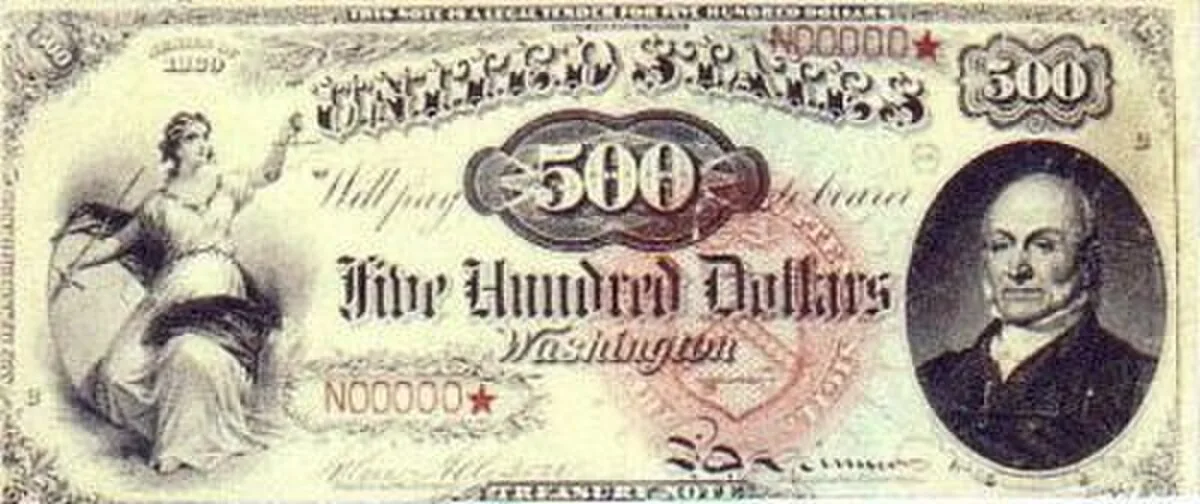
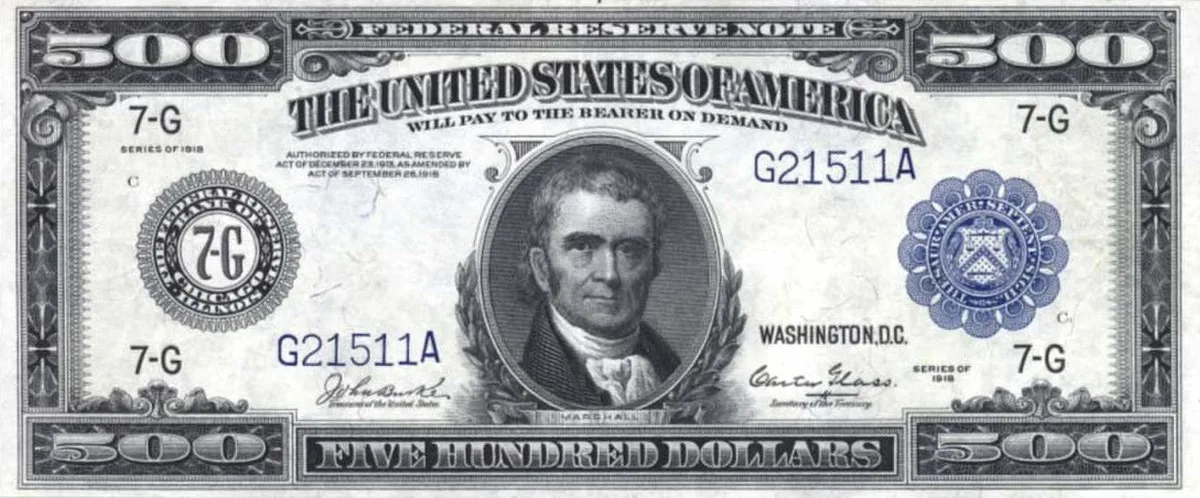
Is there a 500 dollar bill?
Yes. The United States issued the 500 dollar bill in multiple historical series. It remains legal tender, but it is no longer printed and is extremely rare in circulation.
Most surviving $500 notes are held by collectors, banks, or institutions. If one does surface in everyday commerce, it is usually treated as a collectible rather than spent like a typical bill.
Who is on the 500 dollar bill?
On the small-size $500 Federal Reserve Notes from the twentieth century, William McKinley appears on the obverse. Earlier series used different portraits, including the 1918 Federal Reserve Note that features a different historical figure.
The variety of portraits reflects the long history of the denomination. When people ask "who is on the 500 dollar bill," they are usually referring to the most familiar small-size issue, which is the McKinley portrait note.
Why the 500 dollar bill existed
High denominations like the $500 bill were designed for large transactions before electronic payments. Banks, corporations, and government agencies used these notes to move significant sums efficiently, especially in an era when wire transfers and digital records were limited.
As financial systems modernized, demand for high-value paper money declined. The $500 bill gradually disappeared from daily use, leaving most remaining notes in collections or bank vaults.
A brief history of the 500 dollar bill
The $500 denomination dates back to the nineteenth century, appearing in several large-size formats with ornate engraving. These early notes look quite different from modern bills, but they established the $500 as a legitimate, high-value instrument. For broader context on the note types of that era, see our history of US paper money.
In 1928, the US introduced the small-size format that standardized the size of paper money. The $500 Federal Reserve Note design from this period is the most recognizable today. High-denomination bills were discontinued in 1969 and are no longer printed, though they remain legal tender.
Design details and visual style
Historic $500 bills emphasize bold numerals, engraved portraits, and strong border work. The design is clean and authoritative, reflecting the note's high value. Even older large-size issues used intricate line work that is difficult to reproduce with standard printing methods.
Unlike modern low denominations, older $500 notes do not include the full suite of contemporary security features. Instead, they rely on detailed engraving, paper quality, and official seals to confirm authenticity.
Understanding series and note types
Collectors categorize $500 bills by series year, issuing authority, and note size. Large-size notes from the nineteenth and early twentieth centuries are generally scarcer than small-size notes, and their artwork can vary significantly from later Federal Reserve Notes.
Details such as seal color, signature combinations, and serial number formats help identify the exact issue. Learning these identifiers is useful when estimating value or researching a specific $500 bill.
Reference catalogs and trusted online price guides can help you compare varieties. Because many issues look similar at a glance, clear photos and careful research are important before buying or selling a high-value note.
Collector value and market demand
Most 500 dollar bills trade well above face value. Scarcity, collector interest, and condition are the main drivers of price. Small-size notes from the 1928 and 1934 series are common in the collector market relative to earlier issues, but they still command premiums. New collectors who want to approach high-value notes carefully should review our beginner's guide to collecting paper money first.
Collectors pay extra for star notes, low serial numbers, and high-grade examples. Professional grading can help establish condition and authenticity, especially for high-value pieces.
If you find a 500 dollar bill
Handle the note carefully and avoid folding or rubbing the surface. If possible, place it in a protective sleeve and note where and how you obtained it. This helps preserve condition and provides useful context if you later decide to sell or authenticate the bill.
For valuation, consult a reputable currency dealer, grading service, or auction house. While you can deposit a $500 bill at a bank, most banks will treat it as a collectible and send it out of circulation, so depositing may not be the best choice if you want to preserve potential premium value.
Handling and verification
If you discover a $500 bill, handle it carefully. Store it flat in an archival sleeve, avoid folding, and do not attempt to clean it. Cleaning can permanently reduce collector value.
For authentication or sale, work with a reputable dealer or auction house. Banks can accept the note as legal tender, but they typically remove it from circulation and send it through official channels rather than reissuing it to customers.
Fun facts about the $500 bill
The 500 dollar bill is one of the most famous discontinued denominations. Many Americans have never seen one in person, which adds to its mystique and collector appeal.
- The $500 note was primarily used for large transactions, not everyday spending.
- It is still legal tender but rarely appears in circulation.
- Collectors value the note for its history as much as its face value.
500 dollar bill FAQ
Is there a 500 dollar bill?
Yes. The US issued $500 notes in the past, and they remain legal tender even though they are no longer printed.
Who is on the 500 dollar bill?
The most familiar small-size $500 bill features William McKinley, while earlier series used different portraits.
Can you spend a 500 dollar bill?
Yes, it is legal tender, but most people treat it as a collectible because its market value is usually higher than face value.
How much is a 500 dollar bill worth?
Value depends on the series, condition, and rarity. Most examples sell for more than $500 in the collector market.