The $100 Dollar Bill
A complete guide to America's highest circulating denomination: Benjamin Franklin's portrait, advanced security features, authentication methods, and the kinds of factors that drive collector value.
Last reviewed on April 27, 2026.
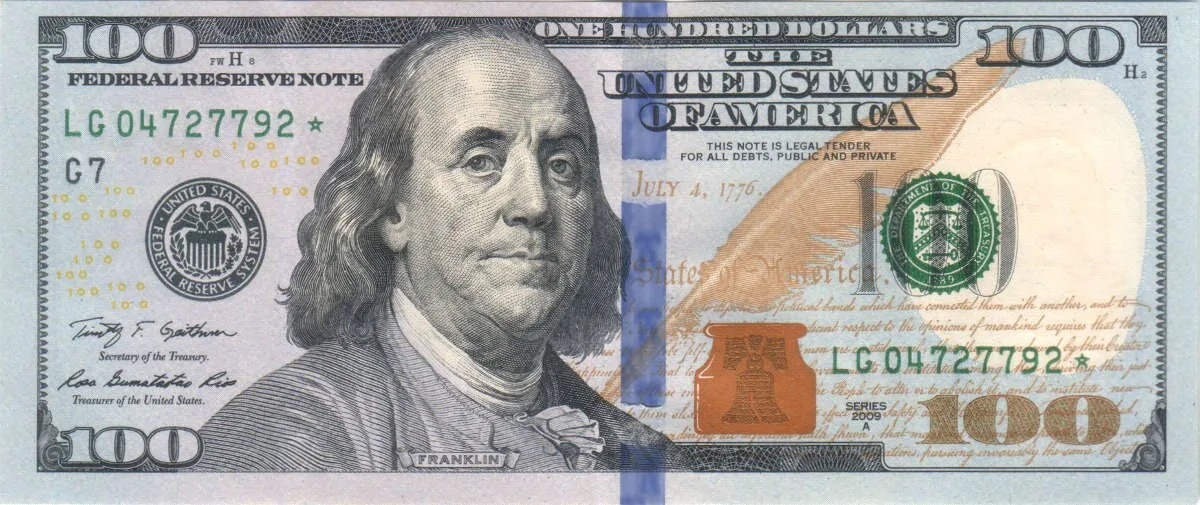
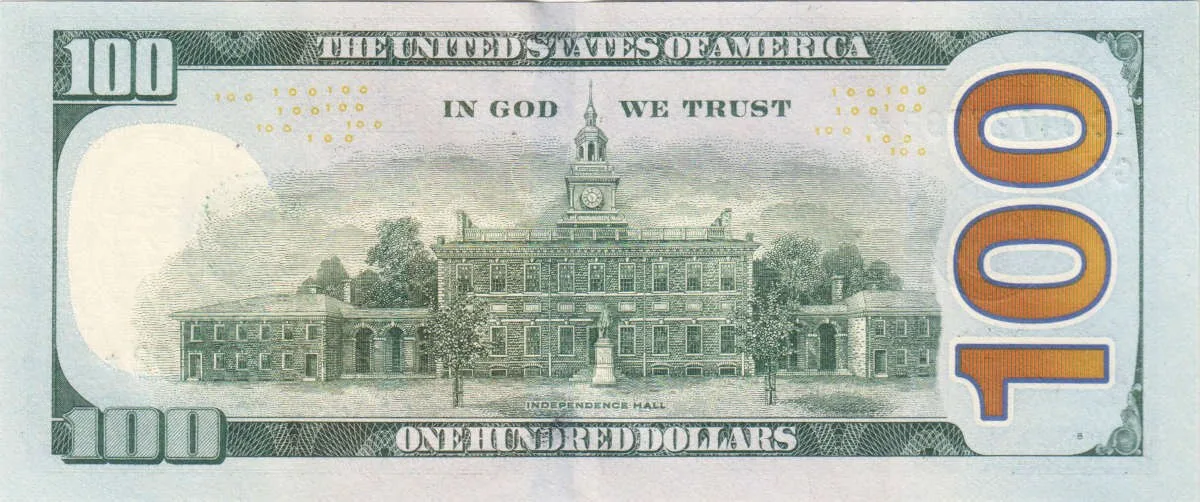
Who is on the 100 dollar bill?
Benjamin Franklin, the founding-era polymath, has appeared on the $100 bill since 1914. Franklin remains the face of America's highest denomination in regular circulation, paired with Philadelphia's Independence Hall on the reverse.
Franklin earned this honor through his multifaceted contributions: diplomat who secured crucial French support during the Revolution, inventor of the lightning rod and bifocals, founder of America's first public library, and publisher of Poor Richard's Almanack. He's one of only two non-presidents on modern US currency.
Evolution of the $100 bill
The $100 bill's journey spans more than 160 years of American monetary history. First issued in 1862 during the Civil War, early "Legal Tender Notes" featured elaborate engravings and were significantly larger than today's currency, measuring around 7.4 × 3.1 inches before the small-size redesign.
The modern small-size format debuted in 1929, standardizing all denominations at today's 6.14 × 2.61 inches. The current $100 design was introduced in October 2013 after years of development and remains the most technologically advanced US banknote in circulation, with security features that took more than a decade to perfect.
Design details: Franklin and Independence Hall
Franklin's portrait is engraved with fine-line detail that is difficult to reproduce, while the seals and serial numbers provide visual confirmation of authenticity. Modern series also include subtle background patterns and color accents to improve recognition.
Independence Hall on the reverse connects the note to the signing of the Declaration of Independence. On the front, the inkwell with the Liberty Bell adds an extra layer of symbolism and a focal point for one of the bill's key security features.
Security features of the current $100 bill
The current $100 bill is the most security-rich US banknote in circulation, with multiple overlapping layers of authentication technology that have proven highly effective against counterfeiting. The design has been in steady circulation since 2013.
- 3D Security Ribbon: The blue ribbon woven into (not printed on) the paper contains images of bells and 100s that move and change from one to the other as you tilt the bill
- Bell in the Inkwell: The copper inkwell contains a color-shifting bell that changes from copper to green when tilted—a bell appears and disappears within the inkwell
- Franklin Watermark: Hold the bill to light to see a faint image of Benjamin Franklin to the right of the portrait
- Security Thread: An embedded vertical strip reads "USA 100" and glows pink under ultraviolet light
- Color-Shifting 100: The numeral 100 in the lower right corner shifts from copper to green when tilted
- Raised Printing: Move your finger across Franklin's shoulder—you should feel the distinctive texture of raised printing
- Microprinting: Look closely to find "THE UNITED STATES OF AMERICA" on Franklin's collar and "USA 100" around the blank space containing the watermark
- Gold 100: A large gold numeral 100 on the back helps those with visual impairments distinguish the denomination
Authentication tip: the most reliable quick check combines three features at once — tilt the bill to see the color changes, hold it to light for the watermark, and feel for raised printing on the portrait. Counterfeiters often replicate one or two of these convincingly, but rarely all three.
Global circulation of the $100 bill
The $100 bill is widely used outside the United States, and a substantial share of all $100 notes in existence is held internationally. That makes it one of the most globally recognized pieces of paper currency, often used as a store of value or for large cross-border transactions in regions where the local currency is less stable.
Many businesses worldwide accept $100 bills but inspect them carefully because of their value. Familiarity with the security features of the current series helps ensure smoother acceptance both at home and abroad. For travelers, carrying a mix of denominations rather than only $100s often makes daily spending easier.
Older series and redesigns
It is normal to see multiple designs of the 100 dollar bill in circulation. Older series without the blue security ribbon are still valid, and all genuine Federal Reserve Notes remain legal tender regardless of design changes.
If you handle an older $100, use the series year on the face to understand which security features to expect. Banks can exchange older notes for newer ones, but most people simply spend them as usual.
When in doubt, compare an older bill with a known authentic note. The paper texture, sharpness of engraved lines, and placement of the watermark and thread should feel consistent for genuine currency.
Collector value and market drivers
Most circulated $100 bills trade at face value, but certain varieties command premiums with collectors. Star notes (serial numbers ending with a star) from short print runs are popular, especially when uncirculated. Distinctive serial numbers — very low numbers, ladders, repeaters, or solids — can also attract premium offers from specialty buyers; our serial number guide explains how to spot each pattern.
Pre-2013 series without the blue ribbon remain popular among collectors, especially crisp uncirculated examples. Large-size $100 notes from before the small-size redesign of the late 1920s tend to be the scarcest, and value depends heavily on series, signature combination, and condition. Error notes such as misaligned printing, ink smears, and missing serial numbers also draw collector interest, but authentication matters because alterations are sometimes passed off as genuine errors.
Why Benjamin Franklin is on the $100 bill
Benjamin Franklin played a central role in early American history as a diplomat, inventor, printer, and public thinker. He helped secure key alliances during the founding era and shaped the country's approach to education, science, and civic life.
Franklin also operated one of the most influential printing businesses in colonial America, producing newspapers and government documents, and he supported early efforts to standardize paper money. As a result, he is one of the few non-presidents on modern US currency, alongside Alexander Hamilton on the $10 bill.
Care and handling
Because the $100 bill carries higher face value, careful handling matters. Store collectible notes in archival sleeves, keep them dry and flat, and avoid folding or cleaning. Cleaning can permanently damage the paper and reduce collector interest. The beginner's guide to collecting covers storage, grading, and where to buy or sell in more depth. If you ever encounter a badly damaged $100 bill, the mutilated currency guide walks through the redemption process.
Fun facts about the $100 bill
The $100 bill is often nicknamed a "C-note" and is the highest denomination in common circulation today. Its modern design is intentionally bold to make it harder to counterfeit and easier to identify at a glance.
- The blue 3D ribbon is woven into the paper, not printed on top.
- Independence Hall links the note to the founding era of the US.
- The $100 is a popular denomination for travel and savings worldwide.
100 dollar bill FAQ
Who is on the 100 dollar bill?
Benjamin Franklin appears on the obverse of the $100 bill.
What is new about the new 100 dollar bill?
The new 100 dollar bill adds a blue 3D security ribbon and a color-shifting bell in the inkwell, along with updated microprinting and other anti-counterfeit features.
How do I check if a 100 dollar bill is real?
Look for the watermark, the embedded security thread, the color-shifting ink, and the raised printing. Tilt the note to see the ribbon and bell change as you move it.