2 Dollar Bill
History, design, and real-world value ranges for the two dollar bill, including the 1976 bicentennial issue.
Last reviewed on April 27, 2026.

Who is on the 2 dollar bill?
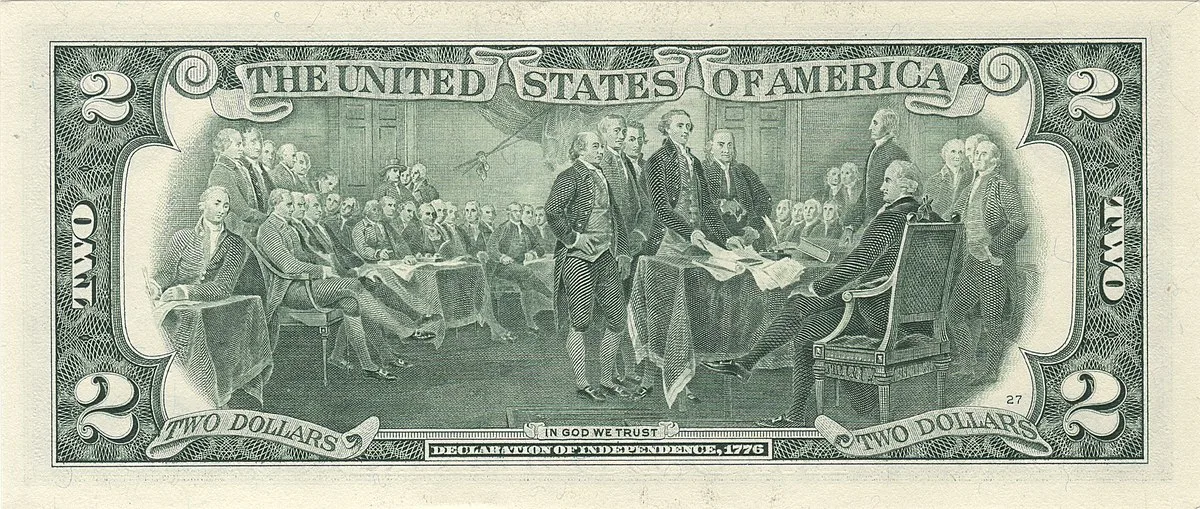
Thomas Jefferson appears on the front of the 2 dollar bill. The reverse features a scene of the Declaration of Independence, based on John Trumbull's painting.
How much is a 2 dollar bill worth?
The value of a 2 dollar bill depends on condition, series year, and unique features like star notes or low serial numbers. Most modern notes trade near face value, while pristine or rare notes can command higher premiums.
| Condition | Typical Value Range | Notes |
|---|---|---|
| Circulated | $2 to $4 | Common modern series usually stay close to face value. |
| Lightly circulated | $3 to $6 | Minor folds with cleaner paper often sell slightly above face. |
| Uncirculated | $5 to $15 | Crisp notes with no folds attract collectors. |
| Special notes | $20 and up | Star notes, errors, or low serial numbers can increase value. |
Values can fluctuate based on demand and grading. For rare notes, consult a professional currency dealer.
How much is a $2 dollar bill worth from 1976?
The 1976 series marked the bicentennial and features the Declaration of Independence on the reverse. Most circulated 1976 $2 bills are worth around face value, while crisp uncirculated notes often sell in the $5 to $12 range. Star notes or exceptionally graded bills can be worth more.
Collector tips for the two dollar bill
Look for clean edges, bright paper, and serial numbers with repeating digits. Keep notes flat and stored in archival sleeves to preserve condition.
History of the 2 dollar bill and its comeback
The 2 dollar bill has a long history that mirrors the broader story of US currency. It first appeared during the Civil War era, when paper money expanded to meet new economic demands. Over time, the two dollar bill shifted through different designs and formats as the Treasury refined and standardized American notes. When US currency moved to the familiar small size in the late 1920s — the same redesign covered in our history of US paper money — the $2 note settled into the basic portrait-and-building layout that collectors recognize today.
Production of the two dollar bill paused in the 1960s, largely because it was not used as frequently as other denominations. That break helped fuel the myth that the $2 is “rare.” In reality, the bill returned in 1976 for the bicentennial, featuring a new reverse design based on the Declaration of Independence painting. Since then, it has remained a current US denomination, though it is printed less often than the $1, $5, or $20 because public demand is lower.
Design details: Thomas Jefferson and the Declaration scene
The front of the two dollar bill features Thomas Jefferson, one of the nation’s most influential founders and the third US president. His portrait gives the denomination a distinctive feel compared to other common notes, and it is paired with classic, detailed engraving that highlights the traditional style of US currency. Earlier $2 designs used other imagery, but the Jefferson portrait has become the enduring identity of the modern note.
The reverse shows an engraving of John Trumbull’s painting of the Declaration of Independence. This scene captures a symbolic presentation rather than a literal moment, which makes it a great conversation piece. Before 1976, the back of the $2 bill displayed Monticello, Jefferson’s home. That swap for the bicentennial made the two dollar bill stand out visually and gave it a reputation as a commemorative note, even though it is a standard Federal Reserve Note.
Why the two dollar bill feels rare in daily life
Many people keep $2 bills as souvenirs, gifts, or novelty tips, which means they often disappear from circulation after being handed out once. That creates the impression that the two dollar bill is rare, but most banks can still order them directly. In everyday commerce, the note is simply less common because demand is lower, not because it has been discontinued. If you want to use $2 bills, you can request them at many financial institutions and spend them like any other US currency.
Because it is slightly unusual, the two dollar bill can spark conversations and even make everyday spending a little more memorable. Some collectors build sets of uncirculated $2 notes, and some people enjoy giving them as small gifts or tips. The note’s cultural reputation is part of its charm, and it continues to be a fun, functional piece of cash rather than a hidden rarity.
Security features and quick checks
Like the $1 bill, the $2 note does not include a watermark, security thread, or color-shifting ink. That does not mean it is easy to counterfeit, but it does mean the best checks are tactile and visual. Authentic $2 bills are printed on a cotton-linen blend with embedded security fibers and fine engraved lines that are crisp and sharp. The portrait should feel slightly raised, and the paper should not feel glossy or soft like standard printer paper.
- Feel the paper and raised printing on Jefferson’s portrait and the Treasury seal.
- Check for fine line engraving and embedded red-blue fibers.
- Compare with a known bill to confirm size and alignment.
- Remember that the absence of a watermark or thread is normal for $2 notes.
If you are unsure, compare the bill with another known authentic note or ask a bank to verify it. The consistency of the paper and the sharpness of the print are the easiest clues.
Collector value beyond face value
The two dollar bill worth depends heavily on condition and series. Modern notes in circulation tend to stay close to face value, while older or better-preserved notes can sell for more. Red seal United States Notes, star notes, and low serial numbers are common starting points for collectors. Some people also collect first-day-of-issue stamped $2 bills from 1976, which can be interesting but do not always command large premiums unless the note is in pristine condition.
As with all paper money, grading matters. Sharp corners, bright paper, and minimal folds push the value higher. If you are building a collection, focus on consistency and documentation rather than chasing a single expensive note. A series-based set of $2 bills can be rewarding and relatively affordable compared to many other collectible categories.
Fun facts about the $2 bill
The two dollar bill has become a symbol of novelty in American culture. It has been used in campaigns to stimulate local spending, has inspired myths about rarity, and remains a popular gift for graduations, weddings, and good-luck gestures. Its reverse artwork is also one of the most elaborate scenes on any circulating US bill.
- The reverse depicts a historical scene rather than a building.
- Many people save $2 bills, which keeps them out of circulation.
- You can still order $2 bills from many banks today.
- The 1976 series coincided with the US bicentennial.
2 dollar bill FAQ
Is the 2 dollar bill rare?
It is uncommon in daily transactions, but it is not rare in the sense of being discontinued. The $2 bill is still a current US denomination and can be ordered through many banks.
How much is a 2 dollar bill worth from 1976?
Most circulated 1976 $2 bills remain close to face value, while uncirculated notes can sell for a modest premium. Star notes and top-graded examples may be worth more.
Who is on the 2 dollar bill?
Thomas Jefferson appears on the front, and the reverse shows the Declaration of Independence engraving based on John Trumbull’s painting.