10 Dollar Bill
Historical context and security features for the ten dollar bill.
Last reviewed on July 25, 2026.
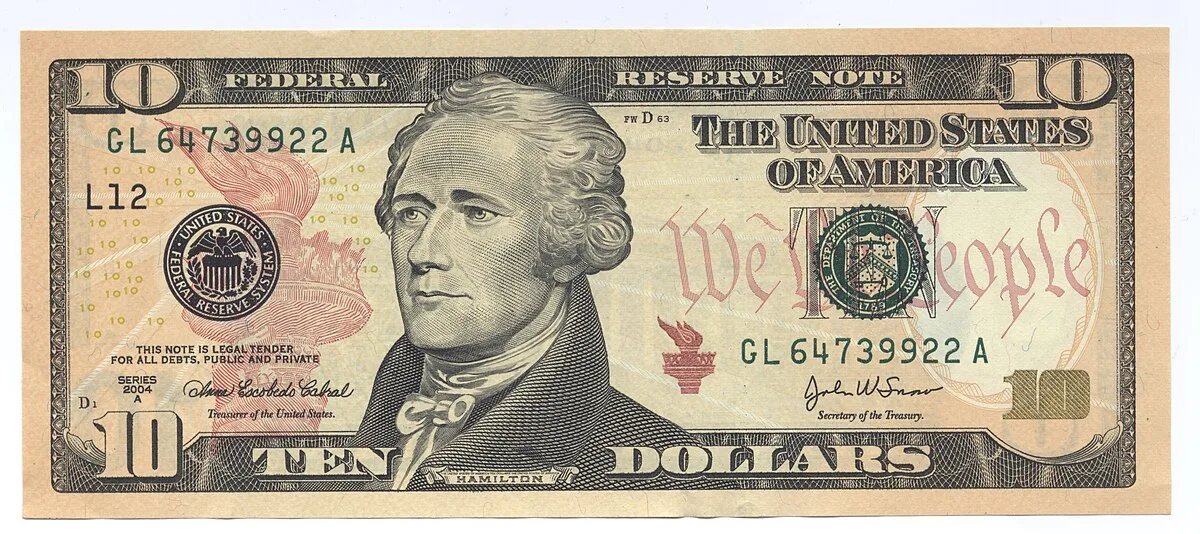

Who is on the 10 dollar bill?
Alexander Hamilton appears on the 10 dollar bill, with the US Treasury Building on the reverse.
Design and security
Modern $10 notes include color-shifting ink, microprinting, and a security thread visible under UV light.
Value and collecting notes
Most 10 dollar bills trade near face value, while older series, errors, and star notes can attract collectors.
A brief history of the 10 dollar bill
The 10 dollar bill has circulated since the Civil War era, evolving through different note types before becoming the modern Federal Reserve Note. Early $10 notes often featured ornate artwork and a variety of portraits, reflecting the artistic style of nineteenth-century currency. As the US standardized its banknotes in the early twentieth century, the ten began to look more like the notes we see today, with a stronger emphasis on portrait engraving and consistent layouts.
Alexander Hamilton has appeared on the $10 bill since the early 1900s, cementing the note’s association with the nation’s financial history. The small-size redesign of 1928 established the format that remains familiar, while a major visual refresh in the early 2000s added color and updated security features. Today’s ten balances classic design with modern safeguards, making it a practical and recognizable denomination.
Design details: Hamilton and the Treasury Building
Alexander Hamilton, the first US Treasury Secretary, is featured on the obverse. His presence links the denomination to the early foundations of American finance and the creation of the Treasury itself. The engraving style is intentionally detailed, which helps preserve the traditional look of US currency and makes counterfeiting more difficult. Many modern $10 bills also incorporate background patterns and color elements that highlight the portrait without overpowering it.
The reverse displays the US Treasury Building, the institutional home of the nation’s monetary policy and public finance operations. The $10 bill also uses scripted design elements like “We the People” and a torch with a stylized backdrop on newer series. These details are not only decorative but also part of the bill’s security design, as their fine lines are challenging to reproduce accurately.
Why Hamilton appears on the $10 bill
Hamilton helped establish the financial foundation of the United States, including the early banking system and federal credit. As the nation’s first Treasury Secretary, he shaped the institutions that manage public finance today, making him a natural figure for a currency denomination.
His placement on the $10 bill also reflects the note’s association with fiscal policy and government finance. While many denominations feature presidents, the $10 stands out by honoring a key architect of American economic policy rather than a head of state.
Security features and quick authentication
Modern $10 notes include multiple security features that are visible and tactile. These elements help the public confirm authenticity without special tools, while also deterring casual counterfeiting. The most common checks involve looking for color-shifting ink, inspecting the watermark, and feeling the raised printing.
- Color-shifting ink on the numeral 10 that changes when tilted.
- A security thread embedded in the paper that glows under UV light.
- A watermark portrait visible when held to light.
- Microprinting around the portrait and borders.
- Raised intaglio printing you can feel with your fingertips.
When you compare a suspected note with a known authentic bill, the consistency of the paper texture and the sharpness of fine lines are usually the most reliable indicators.
Circulation and everyday use
The ten dollar bill is a common denomination for everyday purchases, ATMs, and cash tips. It sits between the frequent $5 and the higher-value $20, making it useful in retail environments where exact change is helpful. Because it is widely used, the $10 bill is printed regularly and sees steady circulation across the country.
The ten is often used for transit fares, quick meals, and smaller retail purchases. That steady movement through cash drawers means older tens tend to show wear faster than higher denominations.
Collector value and notable series
Most modern $10 bills are worth face value, but collectors seek special serial numbers, star notes, and printing errors. Older notes with unique seals or historical note types can be more valuable, especially when well preserved. Condition plays a major role: crisp, uncirculated notes can command premiums that worn bills cannot.
If you are collecting tens, consider building a set by series year, Federal Reserve district, or design style. This approach provides a clear path to growth while keeping the collection organized and educational. As always, proper storage in archival sleeves helps preserve long-term value.
Fun facts about the $10 bill
The ten dollar bill is often used in discussions about US currency redesigns and accessibility. Because it is a moderate-value note, it is visible in both commerce and collecting circles. The combination of Hamilton’s portrait and the Treasury Building makes the $10 one of the most thematically consistent denominations in the series.
- Hamilton’s portrait has appeared on the $10 for over a century.
- The reverse features the US Treasury Building in Washington, D.C.
- Modern series introduced color elements to improve security and recognition.
10 dollar bill FAQ
Who is on the 10 dollar bill?
Alexander Hamilton appears on the obverse of the $10 bill.
What building is on the 10 dollar bill?
The reverse features the US Treasury Building, a landmark tied directly to the nation’s financial history.
How do I check if a 10 dollar bill is real?
Look for the watermark, the security thread, color-shifting ink, and raised printing. These features are standard on modern $10 notes.